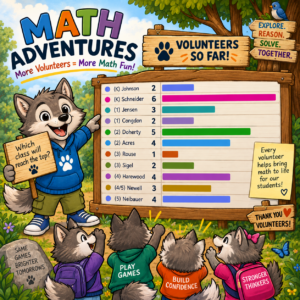
Everything you need to choose a game, prepare with confidence, and help students explore math together.
Before Your Session
2+ weeks before: Explore & play
Choose candidate games. Borrow and play the games so you can explain them easily.
1 week before: Choose together
Finalize games with the other volunteer(s). Keep a second game in mind as a backup.
1–2 days before: Sync with the teacher
Email your game choice and time so the teacher can offer feedback and confirm the schedule.
Be a guide while students play. Help them build strategy and cooperation, give every student attention, and leave space for their ideas.
Leading a Math Adventures Session
This section contains tips that apply across grade levels and game choices. Use them to understand your role, plan the flow of a session, and support students as they play, collaborate, and work through challenges. Adapt the guidance to your group and coordinate with the classroom teacher as needed.
Please visit the Math Adventures Game Inventory to explore our selection of games.
Select a section below to expand the full guidance.
Introduction
Thank you for volunteering for Math Adventures! Your time and energy help students actively engage in playful problem-solving, spatial reasoning, and other key skills, while also giving you the rewarding opportunity to connect with students and watch their confidence and abilities grow.
This guide will help you prepare and lead a session, with volunteer responsibilities, session structure, practical tips, and learning goals by grade. The Math Adventures Game Inventory provides game recommendations and additional materials.
Volunteer Responsibilities
Volunteer
Before your session
- 2+ weeks before: Review the learning goals for your grade and choose game candidates using the Math Adventures Game Inventory. Borrow and play the games so you can explain them easily.
- 1 week before: Contact the other volunteers and finalize your game choices. Keep a couple of backup games in mind in case students need a change of pace. Don’t be afraid to choose a game that challenges them.
- 1–2 days before: Email the teacher your game choice and time. This confirms the schedule and gives the teacher a chance to offer feedback or connect the activity to the school day.
During your session
- Introduce the game, oversee students as they play, and guide cleanup.
- If you have time, take and upload photos for the yearbook. Do not share student photos on social media.
- Take a final inventory of the games used and return them to the appropriate shelf.
After your session
- Share which games were played so future volunteers can avoid repetition.
- Connect with the other parents about your experience.
- If your students were particularly well behaved, drop a note to their teacher
Class Lead
- At the beginning of the year, coordinate the schedule and session dates with the teacher.
- Create a signup form and circulate it among classroom volunteers.
- Include two volunteers and one backup for each session.
- How to use the integrated signup system – Wilder PTSA
- Check in with the volunteers and teacher a few days before each session.
Chair
- At the beginning of the year, organize the program kickoff
- publish the initial signup form
- build awareness of and enthusiasm for the program
- identify classroom leads
- At the end of the year, update the inventory spreadsheet.
Session Structure & Guidance
Roughly half the class participates in Math Adventures at once. Repeat steps 1–3 for each group.
1. Introduce the game
- Decide whether to introduce the game to the whole group or split it into two groups, each led by a volunteer. Smaller groups work well for younger students, complicated explanations, or new ideas; a shared introduction can work well for familiar games and quick variations.
- Explain the game in your own words. Start with the objective, then show how to reach it with an example instead of reading the instructions word for word.
- Check understanding with questions. Yes/no call-and-response and playful counterexamples (“Should I…?”) can keep students engaged.
- Choose the first player with a math activity: guess a number closest to yours, compare ages or birthdays when appropriate, or roll dice and compare, add, or multiply the results.
- Pass out supplies after explaining the game, especially when there are noisy dice.
2. Guide students as they play
- Oversee the games rather than playing yourself. This lets students build strategy and cooperation, keeps you available as an impartial moderator, and allows you to move between groups.
- Spend time with every student, including quieter students and students other than your own child.
- As students become familiar with a game, offer variations and invite them to design their own.
- Help students reflect by noticing when something is especially fun or challenging.
- Many students need to move or wiggle to stay engaged. Help them stay in their own space without crowding others.
3. Wrap up each group
- Give a few minutes’ warning so students can finish a round, decide on a winner if needed, or find another form of closure.
- Ask for a quick thumbs-up or thumbs-down about the game, or a playful cheer.
- Have all students help put the pieces back in their bags or boxes and leave them on the tables.
- Line students up at the door for a quiet walk back to class.
4. Wrap up the session
- Count the pieces in each game used, including dice and other components. Restock as needed from the partial-games section.
- Return games to the complete or incomplete shelf as appropriate.
- If pieces are missing, tell the teacher. They may locate them and can reinforce that pieces need to stay with the games.
- Write the missing pieces and date on a sticky note, attach it to the top of the box, and place the game on the incomplete shelf.
Materials
The most actively used materials are in the Plum Creek pod room, next to the front parking lot. From the main office, go past the library and take the first left. Additional materials are in the Silver Lake pod room; continue straight after passing the library.
Games and Binders
- Games: Complete and incomplete sets are kept on separate shelves.
- Binders: There is one for each grade level. They include instructions for older and discontinued games, additional ways to use the games and other math activities, and notes from past volunteers.
If you can’t find a game, check in the pod room common areas — especially in the younger grades, teams will sometimes set them aside for a few weeks close to where they will be used.
Behavior
Students in Math Adventures are expected to follow the same rules as in the classroom: listen, use inside voices, and be respectful of other students and parent volunteers. Often a simple reminder or redirect can help a student stay or get back on track or feel heard when they most need it.
Recognize good behavior
Many teachers have a system for reinforcing good behavior. When your group works well together, drop a quick note to the classroom teacher. Students may earn marbles, swag tags or brownie points for their good behavior during Math Adventures!
Help students work through disagreements
- First seek to understand what happened and what is causing any upset feelings.
- Use your judgment to help resolve the situation. In an age-appropriate way, invite students to discuss alternatives, solutions, and how to make things right.
Respond calmly and clearly
- Describe the specific behavior that needs to change and explain or discuss what the student should do instead. For example: “Please do not shout in the room; use an inside voice,” or “We do not throw game pieces; please go pick it up.”
- Use the hallway for a less-public conversation with one or two students when needed.
- Move students to other chairs or groups when a change in group dynamics could help.
Follow the warning and return-to-class process
Students can receive one warning or behavior correction. If there is a second instance, walk the student back to the classroom and explain to the teacher why they are returning early. Reminding students of this after the first warning can help them settle down.
Learning Goals by Grade
Wilder’s math curriculum is largely based on Illustrative Mathematics. Each grade section below summarizes key learning objectives in bullet points and links to external blog posts about how learning progresses through that grade.
Use these summaries and links, along with what students and teachers share about current classroom learning, to help choose your games. As you play together, notice what students enjoy and what stretches their thinking; those observations can guide your next choice.
Kindergarten
Grade-Level Learning Goals
Students build a strong understanding of numbers and what counting means, connecting quantities, spoken numbers, and written numerals. They use counting to compare quantities, begin addition and subtraction by putting together and taking apart groups, explore numbers through 20, and develop early geometric reasoning with shapes.
Number Recognition
- Recognize numbers in different forms, including Arabic numerals (like “3”), number words (“three”) and by connecting the number to the quantity it represents (a picture of 3 umbrellas)
- Practice understanding cardinality – the last number counted tells how many are in a group
Compare Numbers
- Learn to determine whether one number or group is greater than, less than or equal to another
- Often involves counting objects and using simple language (for example, “more,” “less,” or “the same”).
Single-Digit Addition & Subtraction
- Explore using small numbers and concrete objects
- Practice adding to a group or taking away from the group to see how quantities change
- Subtraction introduced in Jan/Feb
Composing and Decomposing
- Learn that numbers and groups can be put together or taken apart in different ways
- For example:
- Combine red and blue hats to make one group of hats, or
- Separate a group of hats into red and blue subsets
Identify Patterns
- Learn to recognize, extend and create simple repeating patterns
- Use shapes, colors, numbers or objects
- Helps to develop early logical thinking, and prepares for mathematical relationships
Counting by 1’s, 2’s, 5’s
- Practice counting in different sequences
- Builds number fluency
- Introduces foundations of multiplication
Grade-Specific Considerations
In kindergarten, you will have a shorter time (15 minutes per group) and the students need a calm, consistent environment without competition. Keep the game’s introduction to less than a minute and set a few clear expectations. Next, help kids practice taking turns, think out loud, and stay engaged while others play. Modify the games to encourage cooperative play instead of defaulting to the very common racing or timed requirements.
Additional Notes:
- The teacher often chooses the game and assigns students to the groups and subgroups
- Each parent takes one subgroup for the duration of the session
- Play only 1 game – the session is short (15min), and students appreciate simplicity
- Instructions and ongoing guidance should be very structured
- Be explicit about what students do when it’s their turn, and when it’s not their turn.
For example, when it’s not their turn, students: - Can wait or help – helpers should count to 10 in their head then give 1 hint
- Cannot crowd or rush the person taking the turn
- Focus on learning about turns and order of play
(conventions like clockwise around the table are new)
- Be explicit about what students do when it’s their turn, and when it’s not their turn.
- Regularly and gently remind students of the rules of the game and of courtesy
- Help individuals and the group with each turn, verify whether their answers are correct
- Encourage advanced students to “show their work”,
helping others at the table to understand how they got their answer
Game Modifications
Kindergarteners often learn best from our games with modifications to remove time pressure and focus on basics of gameplay and cooperation. Below is an example of how to modify games to make the play more effective.
Quick Flip
- Facilitator removes all cards with roman numerals
- Instead of a race to state the number,
students take turns flipping a card and stating the number
First Grade
Grade-Level Learning Goals
First graders build an understanding that numbers are composed of tens and ones, forming the foundation for how place value organizes our number system and supports efficient calculation. The first four objectives below highlight key elements of this year-long progression.
Fluency and Speed within 10
Students develop quick and accurate recall of basic addition and subtraction facts within 10. This fluency frees up mental energy for understanding place value and solving more complex problems.
Grouping by Tens
Students learn that ten ones can be bundled into a single unit called a “ten,” often using tools like ten-frames. They practice composing and decomposing numbers (e.g., 32 as 3 tens and 2 ones or 2 tens and 12 ones) and forming a new ten when adding (e.g., 68 + 6), building a foundation for regrouping into the correct place value.
Addition Within Each Digit
Students add numbers without crossing a ten, such as 12 + 5, reinforcing that only the ones place changes. They also add two-digit numbers without regrouping (e.g., 42 + 35), focusing on combining tens and ones separately.
Two-Digit Addition within 100
Students apply place value strategies to add within 100, including problems that require regrouping. This builds accuracy, flexibility, and confidence with larger numbers.
Measuring Length
Students measure, compare, and order objects by length using both standard and non-standard units. These experiences connect number concepts to real-world contexts.
Second Grade
Grade-Level Learning Goals
Second graders deepen their understanding of numbers and operations while beginning to think more flexibly about how math works. They build fluency, strengthen place value knowledge, and start applying strategies to solve a wider range of problems.
Foundations of Algebra
Students begin to understand equations and unknowns, recognizing that numbers can represent quantities that can change. They explore simple relationships and balance in equations, laying the groundwork for algebraic thinking.
Fast Addition & Subtraction and Equations
Students build speed and accuracy with addition and subtraction facts, developing strong mental math skills. They also represent word problems as equations, connecting numbers, symbols, and real situations. Students work with hundreds, tens, and ones, using place value to add and subtract larger numbers. They build on their knowledge to regroup with the official “carry and borrow” strategy.
Flexible Problem Solving and Real-Life Application
Students learn that there are multiple ways to solve a problem and practice choosing methods that make sense to them. They apply math to real-world situations, strengthening understanding and confidence. Students focus on understanding why strategies work and selecting appropriate approaches for different problems. They begin to explain their reasoning and compare different solution methods.
Graphing and Organizing Data
Students collect, represent, and interpret data using charts, tables, and simple graphs. They use this information to answer questions and make comparisons.
Grade-Specific Considerations
Second graders are ready to develop and compare multiple strategies, collaborate with peers, and engage in light competition and timed play. Turn-taking is still important but largely internalized; many students stay engaged during others’ turns by predicting outcomes or suggesting alternative approaches. This is a great age to introduce variations, invite their ideas, and offer a second game partway through a slightly longer (20–30 minute) session.
Their growing independence supports smaller groups and allows facilitators to move between groups every few minutes, giving students the benefit of multiple perspectives. Your role is to guide the rhythm—slowing things down when needed, drawing quieter students in, and giving fast finishers meaningful roles so the energy stays focused.
Third Grade
Grade-Level Learning Goals
Students make the big transition into multiplication, division, and fractions, building these new ideas from familiar concepts like equal groups, arrays, addition, and measurement. They also strengthen addition and subtraction within 1,000 and apply all four operations to area, measurement, perimeter, and problem solving.
Multiplication & Division
Understand multiplication as equal groups and arrays, connect multiplication and division, and develop fluency with multiplication and division facts within 100.
Addition & Subtraction
Add and subtract within 1,000, using place-value understanding and increasingly efficient strategies.
Place Value
Understand numbers within 1,000 and use place value to compare, calculate, and round to the nearest 10 or 100.
Fractions
Understand fractions as numbers, represent them on a number line, and compare fractions with the same numerator or denominator.
Area & Perimeter
Measure and calculate area and perimeter, connecting rectangular area to multiplication and arrays.
Measurement
Measure and reason about length, time, liquid volume, and weight, including solving problems using measurements.
Problem Solving
Solve one- and two-step problems using all four operations and represent thinking with drawings, diagrams, expressions, and equations.
Fourth Grade
Grade-Level Learning Goals
Students deepen their multiplicative and fractional reasoning, working with factors and multiples, fraction equivalence and operations, decimals, and larger place values. They extend these ideas to multi-digit multiplication and division, measurement conversions, and increasingly complex problems.
Multiples & Factors
Understand factors, multiples, factor pairs, and prime/composite numbers, while building fluency with multiplication.
Place Value
Understand, compare, order, and round large numbers, while also developing an understanding of tenths, hundredths, and decimal notation.
Multiplication & Division
Multiply and divide larger whole numbers using place value and efficient strategies.
Fractions
Understand and compare equivalent fractions; add and subtract fractions and multiply fractions by whole numbers.
Unit Conversion
Reason about relationships between measurement units and solve conversion problems.
Problem Solving
Use diagrams, equations, and mathematical reasoning to solve problems, including multiplicative comparison and measurement problems.
Fifth Grade
Grade-Level Learning Goals
Students extend multiplication and division to more complex numbers and situations, including multi-digit computation, fraction multiplication and division, and volume. A major emphasis is understanding why fraction operations work and connecting models and reasoning to efficient calculation methods.
Volume
Understand volume as layers or arrays of unit cubes, connect those structures to multiplication, and use formulas to find the volume of rectangular prisms.
Fraction Division
Understand fractions as division, such as recognizing 3/4 as 3 ÷ 4, using sharing situations and diagrams.
Fraction Multiplication
Multiply whole numbers by fractions and fractions by fractions. Use models and reasoning to understand what the multiplication represents, not just apply a rule.
Unit Fractions
Divide unit fractions by whole numbers and whole numbers by unit fractions, such as 1/2 ÷ 3 and 3 ÷ 1/2, and interpret what the results mean.
Multiplication
Develop fluency with multi-digit multiplication, including the standard algorithm, while connecting procedures to place value and multiplication reasoning.
Division
Divide multi-digit whole numbers using increasingly efficient strategies and connect those procedures to an understanding of division.
Reasoning
Model situations, notice patterns, explain strategies, and connect informal approaches to mathematical expressions.